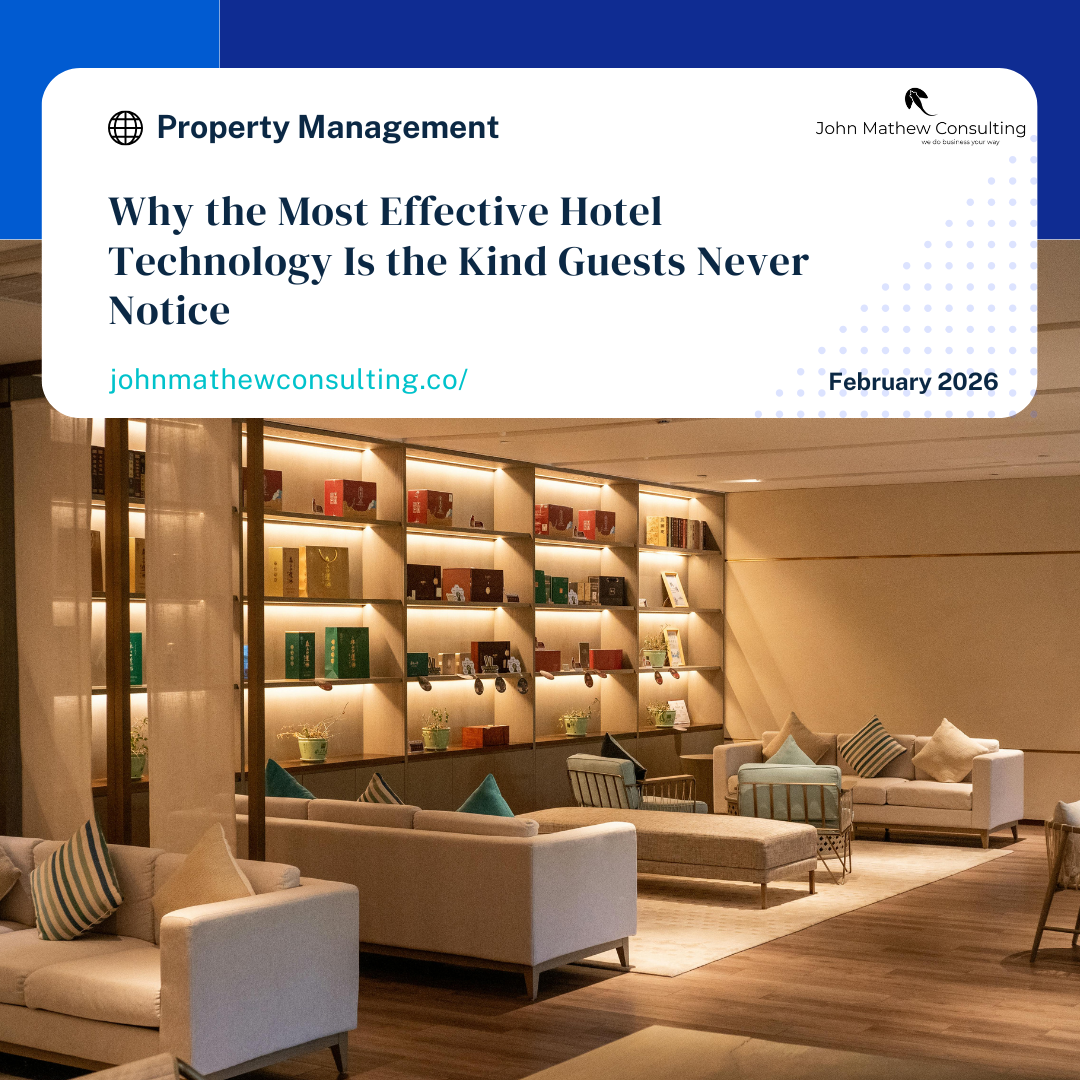
Why the Most Effective Hotel Technology Is the Kind Guests Never Notice
For years, the hospitality industry has chased the idea of the “smart hotel.” Smart rooms, smart controls, smart check-in, smart everything. The assumption has been simple: more technology equals a better guest experience.
In practice, the opposite is often true.
Guests do not travel to learn systems, manage interfaces, or troubleshoot devices. They travel to rest, to work, to connect, and to move through their day with as little friction as possible. When technology becomes visible, it usually means something is broken, confusing, or getting in the way.
The most effective hotel technology doesn’t impress guests. It disappears.
From Feature-Led to Behavior-Led Design
Modern travel no longer fits into clean categories of “business” or “leisure.” A single hotel room may serve as a workspace in the morning, a video call studio in the afternoon, and a recovery space at night. Technology has to support all of these use cases without becoming another responsibility for the guest.
This requires a shift in mindset. Instead of asking what technology can we add, high-performing operators ask how do guests actually behave in this space.
When technology is designed around real behavior rather than novelty, it stops demanding attention and starts delivering value.
Power Is Assumed—Ease Is What Differentiates
Access to power is no longer an amenity. It is an expectation.
What guests notice is not whether power exists, but whether it is easy to use. Outlets that are hard to reach, outdated USB ports, or wireless chargers hidden in impractical locations create immediate frustration.
Hotels face a structural challenge: buildings evolve slowly, while devices change rapidly. Chasing every new charging standard through constant retrofits is unrealistic.
The more durable approach is flexibility:
Accessible standard outlets
Logical placement near beds, desks, and seating
Allowing guests to use their own cables and chargers without compromise
When power feels adaptable and effortless, it fades into the background—exactly where it belongs.
Wi-Fi Is Not an Amenity. It Is the Room.
Few factors shape guest perception faster than connectivity.
Fast, stable Wi-Fi is foundational infrastructure, not a premium upsell. In 2026, charging for basic connectivity or forcing guests through outdated captive portals signals misalignment with reality.
For many travelers, especially those blending work and travel, the network is the room. Video calls must work. VPNs must connect. Uploads must be reliable.
Hotels that get this right rarely advertise speeds or bandwidth. Guests simply notice that everything works—and move on.
A Workspace That Acknowledges Reality
Design-forward furniture that fails at basic function is a common misstep.
If a guest opens a laptop, the room should support that action naturally:
Sufficient desk space
Comfortable, supportive seating
Proper task lighting
Easily accessible power
This is no longer a premium feature. It is foundational. When hotels ignore how rooms are actually used, guests are forced to improvise—and improvisation is experienced as friction.
Automation Should Empower, Not Instruct
Smart lighting, climate controls, and automated shades can improve comfort—but only when they are intuitive.
Guests do not want to learn new systems after a long day of travel. Physical switches still matter. Clear labels still matter. Automation should enhance comfort while remaining easy to override.
The objective is not maximum automation. It is appropriate automation—technology that supports choice rather than dictating behavior.
Sustainability Works Best When It’s Invisible
Energy efficiency is no longer optional, but it should never feel punitive.
Motion-based climate control, smart sensors, and efficient systems are most effective when they operate quietly in the background. Poorly designed systems feel like the hotel is fighting the guest. Well-designed systems preserve comfort while reducing waste.
The difference is intent: technology designed to balance sustainability and guest experience performs far better than technology designed purely to cut costs.
Reducing Friction Beyond the Room
The guest experience begins long before the room door opens.
Check-in, checkout, payments, and policies are prime opportunities to reduce friction. Mobile check-in, kiosks, and digital keys are not about appearing futuristic—they are about compressing time, reducing lines, and removing unnecessary steps.
At the same time, effective systems preserve access to human support when it is actually needed. Technology should eliminate avoidable conversations, not meaningful service.
The Competitive Advantage of Restraint
Some of the most successful hotels today do not feel high-tech at all.
They feel calm.
They feel predictable.
They feel reliable.
This is not accidental. It is the result of disciplined decision-making—choosing technology that solves real problems and rejecting technology that exists only to signal innovation.
At John Mathew Consulting & Property Management, we consistently see this pattern across properties we advise and manage. The strongest performers are not those with the most technology, but those with the least friction.
Final Perspective
Modern hotel luxury is no longer defined by how much technology is visible.
It is defined by how little guests have to think about it.
When a room works the way guests expect—without explanation, instruction, or interruption—technology delivers its highest return. Most guests will never comment on it.
Ready to Align Your Hotel Technology with Real Guest Behavior and Operational Value?
Schedule a strategic consultation with John Mathew Consulting & Property Management to evaluate how your technology investments can reduce friction, enhance experience, and improve asset performance.
➡️ Book your 1-on-1 consultation: https://calendly.com/johnmathew/1st-consultation-conversation