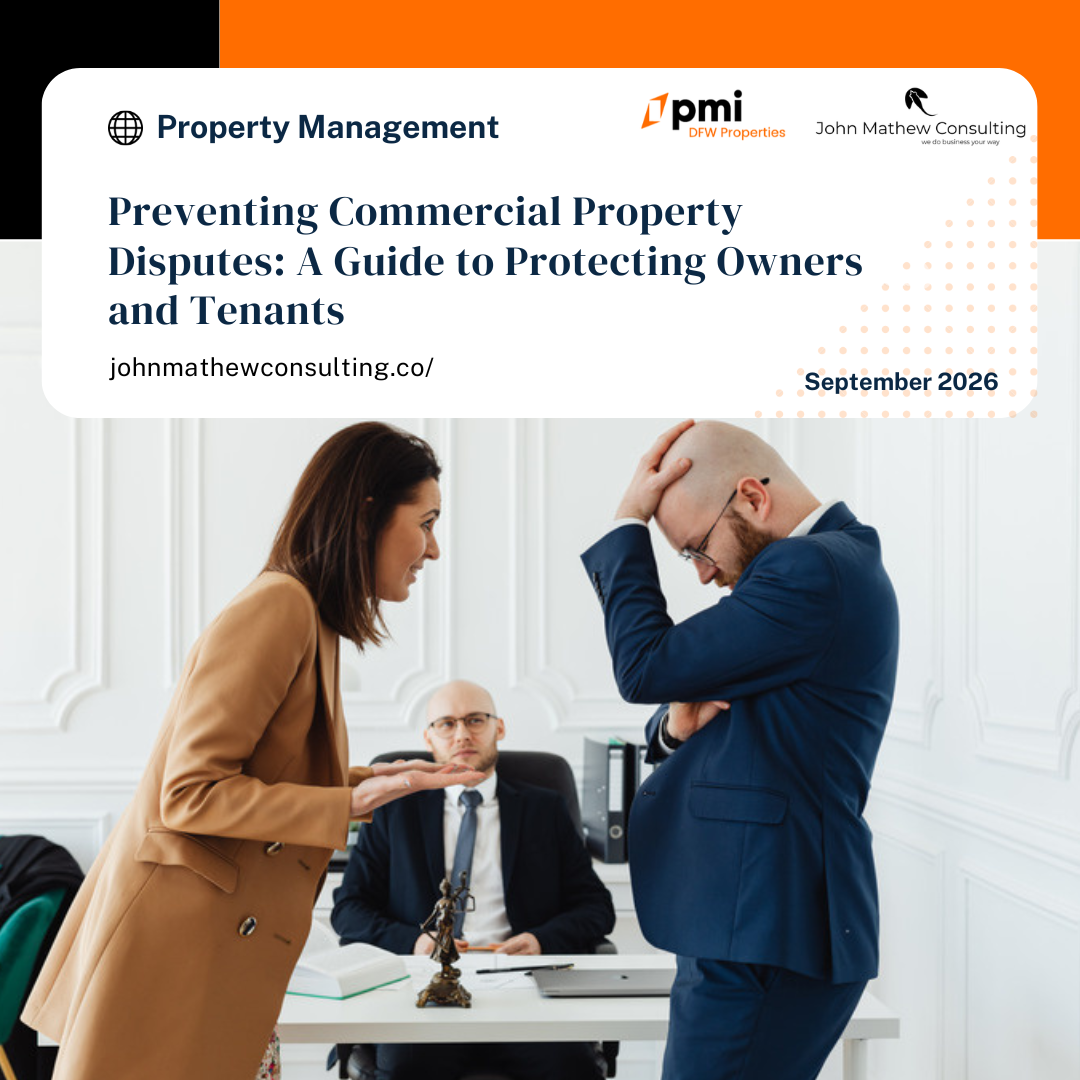
Preventing Commercial Property Disputes: A Guide to Protecting Owners and Tenants
Commercial property disputes rarely begin with a major confrontation.
More often, they start with something small: a maintenance request that was not addressed, a disagreement over a charge, unclear lease responsibilities, a parking issue, or a tenant who feels their concerns are being ignored.
If these issues are not addressed early, they can quickly become expensive, time-consuming problems for both the property owner and the tenant.
Effective commercial property management is not simply about collecting rent and responding to maintenance requests. It is about creating systems that prevent small operational issues from becoming major disputes.
Clear Communication Starts With Clear Expectations
Many disputes are caused by misunderstandings rather than intentional wrongdoing.
Tenants need to understand what the lease requires, what the property manager is responsible for, what the tenant is responsible for, and how issues should be reported.
Property managers should establish clear communication procedures for:
Maintenance and repair requests
Rent and operating expense questions
Lease notices and renewals
Property rules and regulations
Parking and common-area concerns
After-hours emergencies
Tenant complaints
When expectations are clearly established, there is less room for assumptions and conflicting interpretations.
The Lease Should Guide the Conversation
When a dispute occurs, the lease should be one of the first documents reviewed.
Commercial leases establish the contractual responsibilities of the owner and tenant. They may address maintenance, repairs, insurance, operating expenses, alterations, defaults, renewals, termination, and other potential areas of conflict.
Property managers should not rely on verbal agreements or assumptions when the lease provides specific requirements.
The goal is not to use the lease as a weapon against the tenant. The goal is to use it as the framework for determining what each party agreed to do.
Document the Problem From the Beginning
Documentation is one of the most important tools available to a property manager.
When an issue is reported, record:
Date and time of the complaint
Tenant or party reporting the issue
Description of the problem
Relevant lease provisions
Actions taken
Vendors or contractors involved
Communication with the tenant
Resolution and completion date
Good documentation creates accountability and provides a record of how the issue was handled.
It also allows property owners to identify recurring problems that may require a larger operational solution.
Resolve Issues Before They Become Personal
A property dispute can quickly become emotional when either party feels ignored or disrespected.
Property managers should focus on the issue rather than the personalities involved.
A professional resolution process should:
Listen to the concern.
Confirm the facts.
Review the lease and applicable documentation.
Determine responsibility.
Communicate the proposed solution.
Establish a timeline.
Document the resolution.
This approach keeps the conversation focused on facts, responsibilities, and solutions.
Recurring Disputes Are Usually a Warning Sign
One dispute may be an isolated incident.
Repeated disputes usually indicate a system problem.
For example, if multiple tenants complain about slow maintenance response times, the problem may not be the individual tenant. The property may have an ineffective maintenance request process.
If tenants repeatedly question common-area expenses, the issue may be insufficient reporting or communication.
If parking complaints continue, the property may need clearer policies or better enforcement.
Property management should not simply resolve the same problem over and over. Recurring problems should trigger an operational review.
Protecting the Owner's Investment
Dispute resolution is not only about keeping tenants happy.
It also protects the owner's investment.
Unresolved tenant issues can contribute to:
Tenant turnover
Vacancy
Lost rental income
Increased legal expenses
Poor tenant relationships
Deferred maintenance
Negative property reputation
Reduced property value
A strong property manager looks beyond the immediate complaint and considers its financial impact on the asset.
The question should not simply be, "How do we resolve this complaint?"
It should be:
"Why did this happen, and what can we change so it does not happen again?"
When Professional or Legal Assistance Is Necessary
Not every dispute can or should be resolved by the property manager.
Issues involving significant financial claims, lease defaults, termination, litigation, regulatory matters, or complex contractual interpretations may require assistance from qualified legal counsel or another appropriate professional.
The property manager's role is to maintain accurate records, communicate professionally, follow established procedures, and escalate matters when necessary.
Knowing when to resolve an issue internally—and when to bring in the appropriate professional—is an important part of responsible property management.
The Best Dispute Is the One You Prevent
Commercial property management should be proactive, not reactive.
Clear leases, consistent communication, documented processes, responsive maintenance, and regular tenant engagement can prevent many disputes before they escalate.
For property owners, effective management means more than maintaining the building. It means creating systems that protect the asset, support tenant relationships, control operating costs, and reduce unnecessary risk.
At John Mathew Consulting and PMI DFW Properties, our approach to commercial property management focuses on the systems behind the property—not simply the problems that appear on the surface.